


Cannabis Bloom Booster Nutrients That Perform
6 min read
A flower room rarely loses performance because it lacks one more bottle. It loses performance when the root zone cannot keep up with reproductive demand. Cannabis bloom booster nutrients can help close that gap, but only when they support a balanced flowering program, clean irrigation, and measurable nutrient uptake. A booster is not a substitute for a complete bloom base. It is a targeted supplemental tool for a defined production objective.
For commercial operators and serious cultivators, the decision is not simply whether to run a bloom booster. The decision is what the crop needs at a given point in flower, what the base formula already supplies, and whether the additional input will improve flower development without creating excess EC, nutrient antagonism, or an uneven finish.
What Bloom Boosters Are Designed to Do
Bloom boosters are supplemental nutrient products used during the flowering cycle to increase the availability of elements associated with reproductive growth. Most are built around phosphorus and potassium, often with added magnesium, sulfur, calcium, micronutrients, carbohydrates, amino acids, or biostimulant components depending on the formula.
Phosphorus supports energy transfer within the plant. During flower development, that energy demand is substantial. Potassium supports water movement, enzyme activity, carbohydrate transport, and flower density. These functions make P and K central to a flowering program, but more is not automatically better. Cannabis plants still require nitrogen, calcium, magnesium, sulfur, and micronutrients throughout bloom to maintain leaf function, nutrient transport, and plant structure.
The best bloom booster works alongside a fully soluble base nutrient rather than competing with it. A properly built program uses the bloom base to establish complete macronutrient and micronutrient coverage, then uses supplements only where a verified production need exists.
Cannabis Bloom Booster Nutrients Need a Complete Base
A common mistake is treating a high-PK additive as the primary flowering fertilizer. That approach can create fast visual changes, but it often leaves the crop short on the secondary and trace elements needed to carry flowers through the bulk and finish phases.
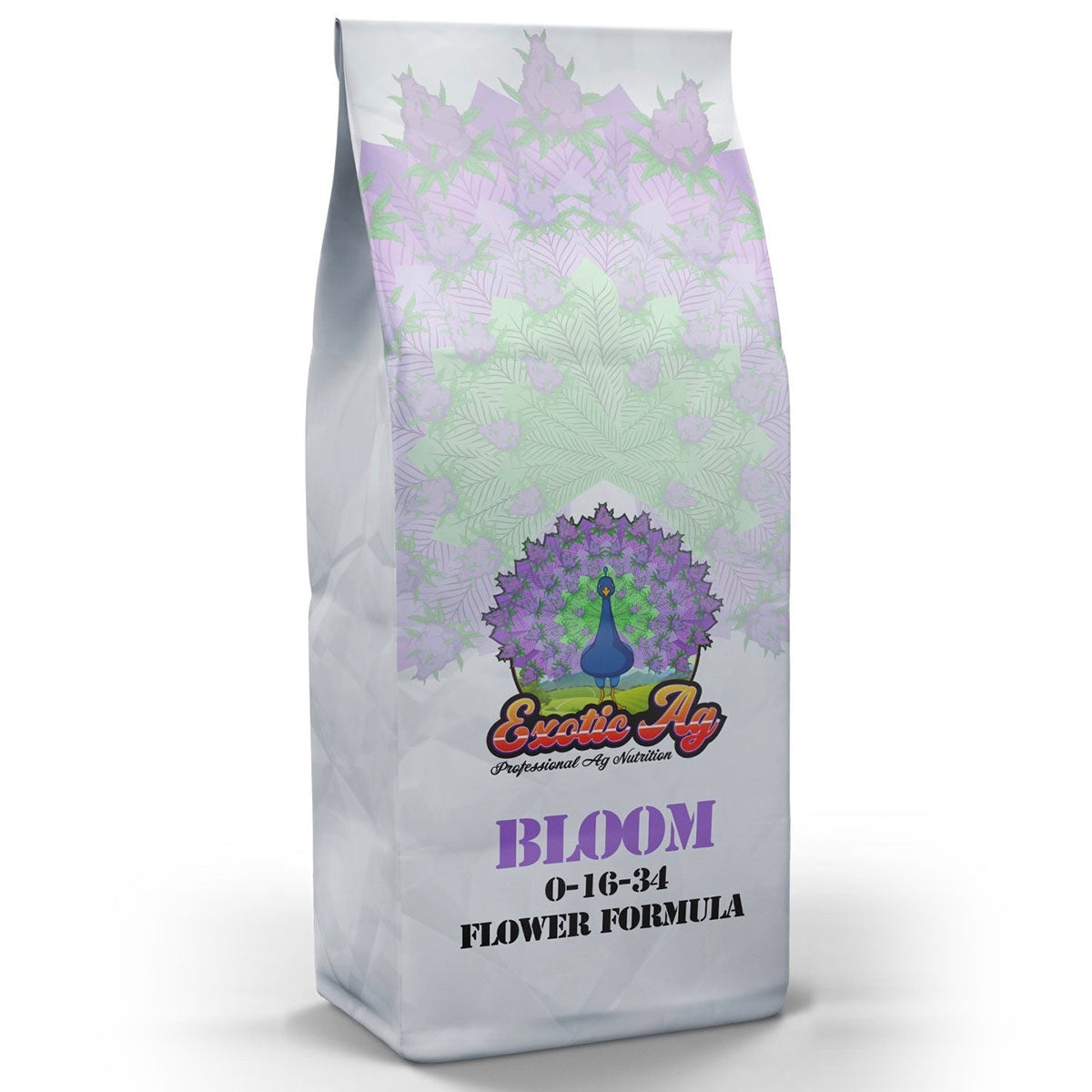
A complete flowering base should provide a known N-P-K analysis plus calcium, magnesium, sulfur, and micronutrients in plant-available forms. Fully soluble products are particularly important in fertigation because they promote consistent mixing, reduce sediment risk, and make it easier to keep each irrigation event uniform. Plant Life Co bloom formulas, including Emerald Bloom Exotic Ag Bloom and Pearl Bloom formulations, are designed for growers building coordinated flowering programs rather than relying on generic single-input feeding.
Once the base is stable, the booster can be evaluated against a specific goal. That may be increasing reproductive support during early set, maintaining potassium availability during flower bulk, or supporting a controlled finish when demand shifts. The base remains the foundation. The booster is the adjustment.
Match the Input to the Stage of Flower
Flowering demand changes from week to week. A product that fits early flower may be unnecessary or counterproductive late in the cycle.
Early Flower: Establishing Set and Structure
During the transition from vegetative growth into flower, plants are still stretching, building new sites, and establishing the structural capacity to hold the crop. Nitrogen should not disappear abruptly at this stage. Excessive early PK can push the root-zone EC upward while the plant is still trying to balance vegetative momentum with reproductive development.
Use a complete bloom fertilizer first. If a booster is introduced, start conservatively and verify that it complements the nitrogen level, calcium supply, and total EC of the base program. Strong early flower performance is usually driven by uniform irrigation, healthy roots, and stable environmental control more than aggressive additive use.
Mid-Flower: Supporting Bulk Without Salt Stress
Mid-flower is when potassium demand often becomes more visible. Flowers are gaining mass, leaves must continue moving carbohydrates efficiently, and the crop needs consistent water uptake. This is the stage where a targeted bloom supplement may earn its place.
The trade-off is concentration. High potassium can interfere with calcium and magnesium uptake if pushed beyond the crop's requirement. The result may be marginal leaf damage, weaker transpiration balance, or a crop that looks heavily fed but performs inconsistently. Watch root-zone EC, irrigation volume, runoff or media readings, and leaf response together. One metric alone does not tell the full story.
Late Flower: Preserve Function and Finish Cleanly
Late flower is not a license to force feed. The goal is to sustain productive leaf area, maintain flower integrity, and guide the crop toward a uniform finish. If plants are already carrying elevated EC or showing reduced water uptake, adding a strong bloom booster can make the problem worse.
A finishing strategy should be based on crop condition, substrate behavior, cultivar response, and harvest timing. Some cultivars maintain demand late into flower; others need a more restrained approach. Clear irrigation water, appropriate drybacks, and a balanced root zone will often contribute more to finish quality than a last-minute high-PK application.
Read the Formula, Not the Front Label
The term “bloom booster” is broad. Two products in the category may have very different effects on your feed program. Review the guaranteed analysis, ingredient forms, solubility, and compatibility before adding any product to a stock tank.
Phosphorus source matters because not all forms behave the same way in water and in the root zone. Potassium source matters because it can change total nitrogen, sulfur, chloride, or carbonate inputs. Calcium-containing products require special attention in concentrated stock solutions, where incompatible materials can precipitate and reduce delivery through the irrigation system.
Micronutrients deserve the same level of scrutiny. Iron, manganese, zinc, copper, boron, and molybdenum are required in small quantities, but deficiencies and toxicities can both develop when pH drifts or when supplements are stacked without a full account of what the base formula already contains.
This is Agricultural Intelligence in practice: make product decisions from the complete nutrient profile and crop data, not from a marketing promise or a single N-P-K number.
Protect the Root Zone Before Chasing More Flower Weight
Nutrient uptake depends on root health, moisture management, oxygen availability, temperature, pH, and salinity. A highly soluble booster cannot compensate for roots sitting too wet, an irrigation strategy that produces excessive dryback, or a reservoir with unstable pH.
Maintain a root-zone pH appropriate to your medium and water source. In most soilless and hydroponic production systems, growers target a mildly acidic range that keeps phosphorus and micronutrients available while supporting calcium and magnesium uptake. The exact target depends on substrate, alkalinity, irrigation frequency, and cultivar response.
Monitor EC in the feed and root zone. A rising media EC combined with declining water use is a warning that inputs may be accumulating faster than the crop can consume them. In that situation, adding more bloom product is not a correction. Adjust irrigation strategy, confirm mixing accuracy, and restore a workable root-zone balance first.
A Preventative Not Curative program also includes sanitation, clean source water, calibrated meters, and frequent checks of injectors and stock tanks. A small mixing error repeated across every irrigation can have a larger impact than the difference between two premium bloom additives.
Avoid the Most Common Booster Errors
The first error is stacking products with overlapping P and K without recalculating the final feed. The second is adding a calcium-magnesium supplement, bloom booster, micronutrient product, and base nutrient as if each operates independently. They do not. Every input changes the total elemental concentration, EC, and ion balance.
The third error is chasing visual symptoms with more fertilizer. Dark foliage, burned margins, stalled water use, or leaf curl can point to excess salts, environmental stress, root disease pressure, poor irrigation timing, or nutrient imbalance. Adding a booster before identifying the cause can compound the issue.
Finally, do not assume every cultivar needs the same flowering intensity. High-vigor, heavy-setting genetics may tolerate a stronger program than a cultivar with lower transpiration or a shorter finish window. Keep cultivar-specific records on feed EC, runoff EC, water use, flower set, and harvest outcomes. Repeatable crop performance comes from those records.
Build a Program That Can Be Measured
The most effective cannabis bloom booster nutrients fit into a measurable crop plan. Start with a complete, fully soluble flowering base. Establish target pH, EC, irrigation frequency, dryback, and runoff or substrate measurements. Introduce a booster at a controlled rate, then assess the effect over multiple irrigation cycles rather than reacting to one day's appearance.
Track flower-site development, canopy color, water use, root-zone EC, and uniformity across zones. If the crop responds with stronger flower development while maintaining stable uptake and clean root-zone readings, the adjustment is likely earning its place. If EC climbs while water use falls, the program needs correction, not more intensity.
The strongest bloom program is usually the one that gives the crop exactly what it can use, at the point it can use it. Keep the root zone balanced, keep the data current, and let consistent plant response determine whether a booster belongs in the tank. https://www.plantlifeco.com/products/diamond-burst-1-5-5