


Cannabis Nutrient Ratios for Every Growth Stage
6 min read
A cannabis crop rarely underperforms because a grower chose the wrong number on an N-P-K label once. It underperforms when cannabis nutrient ratios are treated as fixed recipes instead of stage-specific tools connected to irrigation volume, substrate, water quality, root-zone EC, and plant demand. A ratio sets direction. Crop steering and measurement determine the result.
For professional and high-value cultivation, the objective is not simply to feed more in flower or push nitrogen in veg. It is to deliver fully soluble nutrition in a balance the root zone can support, then adjust that balance before leaf color, growth rate, or flower set signal a preventable problem. That is Preventative Not Curative crop management in practice.
What Cannabis Nutrient Ratios Actually Tell You
The three numbers on a fertilizer label represent the guaranteed analysis of nitrogen (N), available phosphate (P2O5), and soluble potash (K2O). They are useful for comparing formulations, but they are not a complete feeding program. The label does not tell you the final concentration in the irrigation water, the amount retained in the media, or whether calcium, magnesium, sulfur, and micronutrients are sufficient at the target EC.
A 20-10-20 and a 10-5-10 fertilizer share the same proportional relationship, but they do not behave identically in a tank. Application rate changes the delivered ppm, and source materials influence solution chemistry and root-zone response. That is why experienced cultivators read N-P-K analysis alongside recommended dilution rates, water alkalinity, injector accuracy, runoff data, and the complete mineral profile.
Ratios are best understood as a starting framework:
- Nitrogen supports chlorophyll production, leaf area, enzyme activity, and vigorous vegetative development.
- Phosphorus supports energy transfer, root activity, early establishment, and reproductive processes.
- Potassium regulates water movement, enzyme function, carbohydrate transport, and flower development.
- Calcium, magnesium, sulfur, and trace elements are not secondary details. They determine whether the crop can use the primary nutrients efficiently.
Cannabis Nutrient Ratios by Crop Stage
Propagation and early rooting
Fresh cuttings and newly rooted plants have limited demand and limited tolerance for excess salts. A mild, balanced nutrient solution with adequate calcium and micronutrients supports root initiation without creating osmotic stress around young roots. High EC during this period can slow establishment, particularly in small plugs, cubes, or lightly buffered media.
Phosphorus has a role in rooting, but loading a propagation feed with excessive phosphorus is not a shortcut to a stronger root system. Root-zone moisture, oxygen, temperature, sanitation, and a consistent low-strength feed matter just as much. Use a purpose-built rooting or cloning input when the crop needs it, then transition into a complete vegetative formula once roots are actively exploring the media.
Vegetative growth
Vegetative plants generally need a nitrogen-forward nutrient profile because the crop is building stems, leaves, branch structure, and photosynthetic capacity. Nitrogen should be adequate enough to produce uniform canopy development, but not so aggressive that internodes stretch, tissue becomes overly soft, or plants enter flower with excessive vegetative momentum.
A grow formula such as Ruby Grow, Exotic Ag Grow, Jade Grow, or Agate Grow is designed to provide a stage-appropriate macronutrient foundation. Selection should be based on the overall program, water source, substrate, and production targets rather than on N-P-K alone.
Watch the crop and the root zone together. Dark, overly lush growth paired with rising media EC may indicate more nitrogen or total fertility than the crop can use. Pale new growth can indicate low nitrogen, but it can also reflect a pH problem, cold root zone, saturated media, or poor irrigation uniformity. Raising feed strength before confirming the cause can compound the issue.
Transition and early flower
The flip to flower is not a switch from high nitrogen to zero nitrogen. During the first weeks of reproductive development, plants still build substantial leaf area, stems, and flower-bearing sites. They require enough nitrogen to maintain productive green tissue while the program begins shifting toward greater potassium support and a bloom-oriented nutrient profile.
A common failure is reducing nitrogen too abruptly while increasing phosphorus too aggressively. The crop may lose momentum, show premature lower-leaf decline, or develop an imbalanced root zone. A measured transition using a complete bloom formula maintains continuity as plant demand changes.
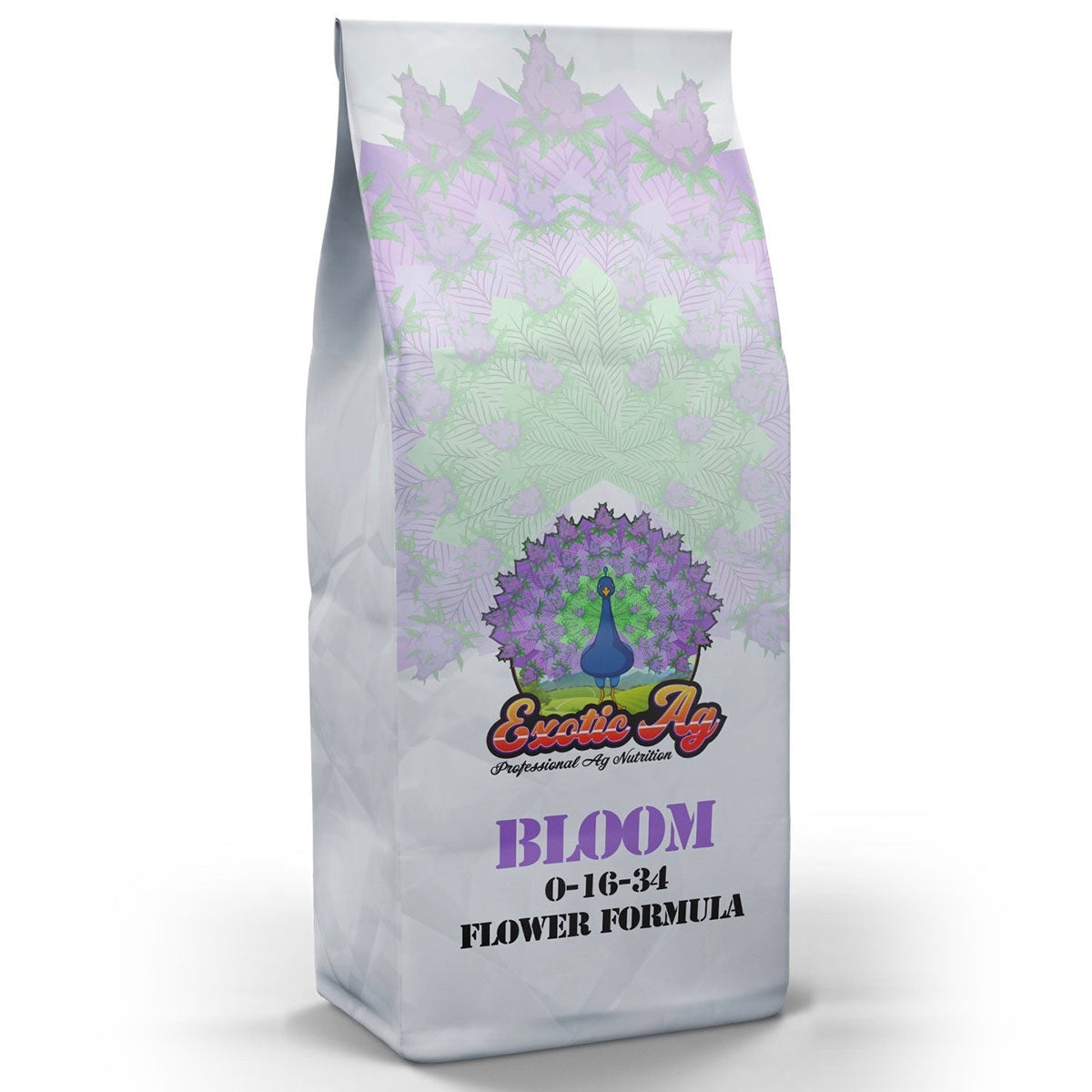
Emerald Bloom, Exotic Ag Bloom and Pearl Bloom formulas can serve this phase when applied within a coordinated program. The correct choice depends on the desired feed concentration and compatibility with the rest of the fertility plan, including calcium-magnesium, silica, and micronutrient inputs.
Bulk flower
In mid-flower, potassium demand becomes more pronounced as plants manage water, move carbohydrates, and develop flower mass. Nitrogen is generally moderated relative to vegetative growth, not eliminated by default. The goal is to sustain healthy, productive leaf tissue without directing excessive energy into late vegetative growth.
This stage is where growers often overcorrect based on the assumption that more phosphorus produces more flowers. Cannabis uses phosphorus, but high phosphorus concentrations do not automatically create larger yields. Excess can raise total EC, disrupt balance with other elements, and make a program harder to manage. Maintain a complete bloom nutrition base, then use supplements only when they serve a defined purpose.
Calcium deserves close attention in rapid flower development. It is relatively immobile within the plant and depends heavily on transpiration and steady root uptake. Inconsistent drybacks, poor airflow, low transpiration, or poor water distribution can create calcium-related symptoms even when calcium is present in the feed. The answer may be environmental correction, irrigation refinement, or improved nutrient balance, not simply more calcium-magnesium product.
Late flower and finish
Late flower nutrition should protect crop quality while avoiding unnecessary residual fertility in the root zone. Nitrogen is often reduced as demand declines, but the correct reduction depends on cultivar behavior, plant health, media type, harvest timing, and the amount of nutrition already available in the substrate.
An aggressive early finish can cause avoidable senescence and reduce the plant's ability to complete flower development. A late crop that remains excessively dark and vegetative may need a more disciplined nitrogen strategy earlier in the cycle. The best finish starts with correct ratios and irrigation management weeks before harvest, not with a last-minute corrective product.
Ratio Is Only One Part of the Feed Program
A nutrient program can have an appropriate N-P-K ratio and still fail operationally. Start with the source water. High bicarbonates can drive pH upward and alter nutrient availability. Water containing meaningful calcium or magnesium changes the amount of supplemental Ca-Mg required. High sodium or chloride can reduce the margin for error in recirculating or low-leach systems.
Then measure what reaches and leaves the root zone. Input EC and pH show what was mixed. Media tests, runoff readings, or substrate extracts show what the plant is actually experiencing. When root-zone EC climbs beyond the intended range, increasing fertilizer concentration because the canopy appears pale is rarely the disciplined move. First determine whether dryback is too severe, runoff is insufficient, emitters are uneven, or pH is restricting uptake.
Nutrient ratios must also be managed for compatibility. Calcium products can react with concentrated phosphates or sulfates if mixed improperly. Always follow a deliberate mixing order, fully dissolve dry fertilizers, and keep incompatible concentrates separated until dilution. Fully soluble inputs improve consistency, but they do not replace sound stock-tank practice.
Build Ratios Around Measurable Crop Targets
For repeatable production, establish stage targets for feed EC, root-zone EC, pH, irrigation frequency, dryback, runoff or leach fraction, and visual crop benchmarks. Record the formulation, injection rate, environmental conditions, and plant response by cultivar. Over several cycles, these records show whether a particular cultivar needs a longer nitrogen-forward vegetative period, a gentler transition, or more potassium support during bulk.
Avoid chasing single leaf symptoms with isolated bottles unless testing and crop context support the decision. A deficiency-like pattern may be caused by restricted uptake rather than a missing nutrient. Correcting the root-zone or irrigation issue protects uniformity across the room and prevents a temporary symptom from becoming a recurring program failure.
Plant Life Co's Agricultural Intelligence approach is built around that discipline: use complete, technically formulated inputs as the base, monitor the variables that control uptake, and make adjustments before performance is compromised.
The most effective nutrient ratio is not the most extreme one on paper. It is the balanced, fully soluble program that keeps roots active, canopy growth uniform, and flower development moving forward with fewer corrective interventions.